

Laser eavesdropping – a hidden threat to your business
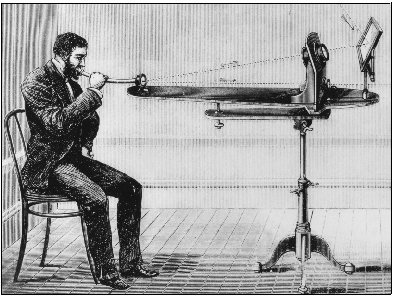 In 1988, newspaper reports about laser beam eavesdropping swept the country. Our customers were frightened. To find out how frightened they should be, we built a laser eavesdropping system and conducted a series of experiments.
A Century Old Invention.
April 26th, 1880 – Alexander Graham Bell & Sumner Tainter announce their invention - the Photophone. Sound was transmitted on reflected light beams over a distance of 213 meters.
Physics 101 (simplified)
Sound is transmitted by vibration. When you speak, you vibrate the air. The air then vibrates everything it touches. Certain objects, such as windows and mirrors, pick up vibrations very easily.
Physics 202 (real world, real problems)
Bouncing an invisible laser beam off a window, and attempting to catch the reflection, is a little like playing 3-D billiards – blindfolded.
Update
Advancements in signal processing have been made since 1988, but the physical problems mentioned above remain.
The Future
Eavesdropping-from-afar technologies such as laser beam, microwave, ultra-wideband will get better with age.
Beat the Beam
Hold confidential conversations in a room without windows. Place a radio against the window and close the curtains. Install a white noise generator on the window pane.
🚨 Laser eavesdropping – a hidden threat to your business
What is laser eavesdropping and why does it threaten you?
A laser microphone is a professional surveillance device that remotely captures sound vibrations on window panes, walls or other objects. Using an invisible laser beam, competitors, industrial spies or unauthorized persons can eavesdrop on your meetings without entering your building.
This technology can be used for:
- Eavesdropping on strategic meetings – competitors can learn your business plans, pricing strategy or acquisition intentions.
- Obtaining confidential information – leakage of know-how, patents, trade secrets or sensitive customer data.
- Monitoring negotiations – law firms, notaries, financial advisors and top managers are frequent targets.
- Industrial espionage – competing companies can capture your innovation processes or technological procedures.
🔍 How does laser eavesdropping work?
A laser beam is directed at the window glass behind which a meeting is taking place. Sound vibrations caused by spoken words make the glass vibrate and the beam is reflected with a slightly modulated wavelength. The receiver then reconstructs the original sound from these reflections.
Main targets of attackers:
- Windows – the most common target, as glass easily transmits vibrations.
- Walls and structures – advanced systems can detect vibrations even through walls.
- Mirrors, paintings, light objects – anything that can vibrate in response to sound waves.
Modern devices can operate at a distance of up to 400 meters and are almost invisible – the attacker does not even have to be near your building.
⚠️ What specific threats do you face?
| Threat type | Description | Risk |
|---|---|---|
| Laser microphones | Capture vibrations of windows and walls. | Leakage of information from meeting rooms. |
| Parabolic microphones | Directional amplification of sound from a distance. | Eavesdropping on external conversations. |
| Stethoscope microphones | Capturing vibrations through walls. | Eavesdropping on adjacent rooms. |
| Ultrasonic surveillance | Uses inaudible frequencies for data transmission. | Covert transmission of information. |
| Radio and GSM bugs | Wireless transmission of the intercepted signal. | Remote access to audio recording. |
📖 Case studies – when protection failed
🔴 Case 1: Trade secret leakage through a window
Industry: Automotive industry
Alert:
A competing company obtained complete technical documentation of the new car model before its official launch. The investigation revealed that the leak occurred through laser eavesdropping of the meeting room, which had windows facing the courtyard. The competition used a laser microphone to capture the vibrations of the window glass during strategic negotiations.
Consequence:
Product recall, loss of investor confidence and 15% drop in shares.
Solution:
After the incident, the company installed vibroacoustic noise generators on all windows and built a stationary 24/7 RF monitoring system.
🔴 Case 2: Eavesdropping on a law firm
Industry: Legal services
Alert:
A law firm representing a major multinational company lost confidential information about a planned merger. The opposing party had precise information about their maximum offer in advance.
Consequence:
Negotiation failure, loss of client and damage to professional reputation.
Solution:
The firm ordered a comprehensive TSCM audit, which revealed the vulnerability of the windows. Subsequently, passive lasers and acoustic protection were installed.
🔴 Case 3: Espionage in a pharmaceutical company
Industry: Pharmaceutical industry
Alert:
Research data on a new drug leaked before it was patented. The competition managed to file their own patent and block the drug's market launch.
Consequence:
Loss of millions of euros in research and development, delay of market launch by 2 years.
Solution:
The company invested in a stationary monitoring system that now 24/7 guards all research laboratories.
🛡️ How to defend yourself? Active and passive protection
1. Acoustic noise generators (white noise)
The most effective protection against laser eavesdropping are vibroacoustic transducers that are attached to windows and walls. They generate white noise that:
- Overlaps the original conversation – makes reconstruction of acoustic vibrations impossible.
- Protects against laser, parabolic and stethoscope microphones – disrupts all methods of vibration sensing.
- Is inaudible to the human ear – does not disturb your meetings.
Important: The effectiveness of this protection must be carefully tested by professional technicians.
2. Passive laser detectors
Systems that continuously monitor the surrounding environment and detect the presence of unknown laser beams. In case of detection, they will immediately alert you.
3. Stationary 24/7 RF monitoring
Permanent scanning of the radio spectrum will reveal any unauthorized transmission (GSM, Wi-Fi, 5G, Bluetooth) in the protected area. The system will alert you to any anomaly.
4. Physical modifications of premises
- Installation of special films on windows that reduce vibrations.
- Use of acoustic curtains and sound-absorbing materials.
- Placing meeting rooms in windowless spaces.
💡 Why is protection essential?
❌ One-time inspection
- Protects only at the moment of inspection.
- Cannot detect pulse eavesdropping.
- Requires repeated ordering and costs money.
✅ Stationary 24/7 system
- Protects non-stop, 365 days a year.
- 100% detects even the shortest transmissions.
- One-time investment in your own infrastructure.
💡 Remember: Modern eavesdropping devices can operate in pulse mode – they activate only after the inspector leaves and transmit data only in short intervals, thus avoiding detection.
🛠️ What can we do for you?
🔍 Security audit
Comprehensive inspection of your premises to identify vulnerabilities (windows, walls, electrical lines).
🔧 Installation of active protection
Installation of acoustic noise generators, vibroacoustic transducers and laser detectors.
📡 Stationary 24/7 monitoring
Installation of a permanent RF scanner with silent alarm.
👨🏫 Staff training
How to recognize potential threats and respond to them.
📞 📞 Don't wait until it's too late
Industrial espionage and illegal eavesdropping are a reality. Every day that your meetings are not protected, you risk leaking sensitive information, losing competitive advantage and damaging your company's reputation.
E-mail: shop@market.sk | Telefón: 0903 040 562